Overview of World War II
World War II was one of the most significant and devastating conflicts in human history, spanning from 1939 to 1945. It involved the majority of the world’s nations, including all major powers, and resulted in dramatic changes to political, social, and economic structures globally. The war was fought between two primary alliances: the Allied Powers, which included the United States, the United Kingdom, the Soviet Union, China, and France, and the Axis Powers, which consisted of Germany, Italy, and Japan. Over the course of six years, the war would expand across Europe, Asia, Africa, and the Pacific, leaving behind a lasting legacy of destruction and transformation.
Brief Explanation of the War’s Global Impact
World War II had a profound global impact, reshaping borders, governments, and societies. The conflict led to the deaths of an estimated 70–85 million people, including civilians and military personnel. It saw the collapse of empires, the rise of the United States and the Soviet Union as superpowers, and the beginning of the Cold War. The war also spurred the creation of international institutions like the United Nations, aimed at preventing such a conflict from happening again.
Key Players (Allied vs. Axis Powers)
The Allied Powers were primarily composed of the United States, the United Kingdom, the Soviet Union, China, and France. These nations formed a coalition against the Axis Powers, which included Nazi Germany, Fascist Italy, and Imperial Japan. While other nations were involved, these were the major players that directed the course of the war.
Duration of the Conflict (1939–1945)
World War II officially began on September 1, 1939, with Germany’s invasion of Poland, and it ended on September 2, 1945, with Japan’s surrender after the atomic bombings of Hiroshima and Nagasaki. In those six years, the war would change the world in irreversible ways, from the fall of dictatorships to the spread of democracy and the onset of the nuclear age.
Importance of Understanding the Chronology
Understanding the chronology of World War II is essential to grasp the complexity and scope of the conflict. Each phase of the war—from the initial invasion of Poland to the final surrender of Japan—represents critical turning points that shaped not only the outcome of the war but also the future of international relations. By tracking the sequence of events, one can better appreciate the interconnectedness of battles, strategies, and political decisions. Knowing when and why pivotal actions occurred helps to explain how the war evolved from a regional conflict into a global struggle and why it concluded the way it did.
Pre-War Events (1933–1939)
Rise of Totalitarian Regimes
The lead-up to World War II was marked by the rise of totalitarian regimes in Europe and Asia, which laid the foundation for global conflict. Among the most significant of these was Adolf Hitler’s rise to power in Germany. In 1933, Hitler, leader of the National Socialist German Workers’ Party (Nazi Party), became Chancellor of Germany. Soon after, he established a totalitarian regime, dismantling the Weimar Republic and consolidating his control over the country. Hitler’s aggressive policies, fueled by his ideology of racial superiority and a desire for territorial expansion, set the stage for the outbreak of war.
Italy and Japan also pursued expansionist policies during this period. Italy, under the leadership of Benito Mussolini, sought to restore the glory of the Roman Empire by expanding its influence in Africa and the Mediterranean. Similarly, Japan, driven by militarist ideals, sought to expand its empire throughout East Asia, beginning with its invasion of Manchuria in 1931 and subsequent aggression in China.
These regimes shared common goals of territorial expansion, militarization, and the subjugation of neighboring nations, which contributed to rising tensions and instability in the global order.
Key Pre-War Agreements and Events
As totalitarian regimes pursued their aggressive policies, several key agreements and events occurred in the late 1930s, further destabilizing the world and paving the way for war.
One of the most pivotal moments came with the Munich Agreement in 1938. This agreement, signed by Germany, Italy, France, and the United Kingdom, allowed Nazi Germany to annex the Sudetenland, a region of Czechoslovakia with a significant ethnic German population. The agreement was seen as an act of appeasement toward Hitler, with British Prime Minister Neville Chamberlain famously declaring it would bring “peace for our time.” However, instead of preventing conflict, it emboldened Hitler, convincing him that the Western powers would not stop his expansionist ambitions.
The following year, on August 23, 1939, Nazi Germany and the Soviet Union shocked the world by signing the Non-Aggression Pact, also known as the Molotov-Ribbentrop Pact. This agreement ensured that neither country would attack the other, allowing Germany to invade Poland without fear of Soviet intervention. The pact also included a secret protocol dividing Eastern Europe into spheres of influence, with Germany targeting Western Poland and the Soviets planning to occupy the east.
These agreements not only failed to prevent war but also accelerated the path to global conflict. The Munich Agreement showed the dangers of appeasement, while the Non-Aggression Pact gave Hitler the green light to launch the invasion of Poland, which would trigger the start of World War II.
Outbreak of War (1939)
Invasion of Poland (September 1, 1939)
The outbreak of World War II began with Germany’s invasion of Poland on September 1, 1939. This aggressive military action, known as Blitzkrieg, involved rapid, coordinated strikes by Germany’s air force, infantry, and armored divisions, overwhelming Polish defenses. Hitler justified the invasion with fabricated claims of Polish provocations against Germany. The swift and brutal attack on Poland marked the official start of World War II, as it broke the fragile peace in Europe. Poland’s forces, though determined, were unable to withstand the might of the German military, and within weeks, the country was overrun.
Declaration of War
In response to the invasion of Poland, the United Kingdom and France, honoring their defense treaties with Poland, declared war on Germany on September 3, 1939. Despite these declarations, neither country was immediately prepared to launch a large-scale offensive. Nevertheless, this marked the official entry of these major powers into the conflict, expanding what had begun as a regional war into a broader European conflict. Poland continued to resist, but by late September, it was fully occupied by German forces from the west and Soviet forces from the east, following the terms of the Molotov-Ribbentrop Pact.
Phony War (1939–1940)
The period following the declaration of war and leading up to active combat in Western Europe is known as the Phony War, or Sitzkrieg, which lasted from late 1939 to early 1940. During these months, despite the official state of war, there was little direct military action between the Allied and German forces along the Western Front. The United Kingdom and France built up their defenses, but aside from minor skirmishes, no major land battles occurred. Meanwhile, Germany focused on consolidating its position in Poland and preparing for future offensives, leaving the Western Front eerily quiet for the time being.
The Expansion of the War (1940–1941)
German Blitzkrieg in Western Europe
In the spring of 1940, the war erupted across Western Europe as Germany unleashed its powerful Blitzkrieg tactics once again, this time targeting Denmark and Norway in April. Both countries were swiftly overrun, with Denmark falling in a single day. This campaign secured Germany’s control over strategic ports and shipping routes in the North Sea. Following these swift victories, Germany turned its attention to Belgium, the Netherlands, and France. In May 1940, German forces invaded these countries in rapid succession, bypassing the heavily fortified Maginot Line through the Ardennes, a region that the Allies had underestimated as a viable invasion route.
Fall of France (June 1940)
The swift and overwhelming nature of Germany’s attacks culminated in the Fall of France in June 1940. After six weeks of intense fighting, the French government, unable to defend against the relentless German advance, signed an armistice on June 22, 1940. Germany occupied the northern part of France, while the southern portion became a nominally independent state under the Vichy regime, which collaborated with the Nazi government. The fall of France shocked the world and left Britain as the sole major Allied power actively resisting German domination in Western Europe.
Battle of Britain (July–October 1940)
Following the fall of France, Hitler sought to subdue Britain through a massive air campaign known as the Battle of Britain, which lasted from July to October 1940. The German Luftwaffe aimed to destroy Britain’s air defenses in preparation for a planned invasion, codenamed Operation Sea Lion. However, the Royal Air Force (RAF), bolstered by radar technology and strong leadership, successfully defended Britain’s skies. By October, Hitler was forced to postpone the invasion indefinitely, making the Battle of Britain the first major defeat for Nazi Germany and a critical moment that preserved Britain as a base for future Allied offensives.
Italy Joins the War
In June 1940, Italy, under the leadership of Benito Mussolini, joined the conflict on the side of the Axis Powers. Motivated by expansionist ambitions and eager to share in Germany’s victories, Italy declared war on France and Britain. Mussolini sought to expand Italy’s influence in North Africa, launching attacks against British-held Egypt and engaging in campaigns across the Mediterranean. Italy’s entry into the war opened new fronts in both North Africa and the Balkans, complicating the conflict for the Allied forces and further expanding the war beyond Europe.
Global Conflict: 1941
Invasion of the Soviet Union (June 22, 1941)
On June 22, 1941, Nazi Germany launched Operation Barbarossa, the largest military invasion in history, targeting the Soviet Union. Hitler sought to crush communism, seize Soviet territory, and secure resources like oil. German forces initially made rapid advances, capturing vast swaths of territory, including Ukraine and Belarus, and encircling entire Soviet armies. The brutal fighting on the Eastern Front would become a decisive theater of the war, characterized by immense destruction and high casualties on both sides.
However, despite early successes, the German offensive slowed as it approached Moscow. The onset of the harsh Russian winter, logistical difficulties, and fierce Soviet resistance, particularly during the Siege of Leningrad and battles around Moscow, stalled the German advance. The invasion marked the beginning of a prolonged and devastating conflict between Germany and the Soviet Union that would ultimately prove disastrous for the Nazis.
Pearl Harbor (December 7, 1941)
On December 7, 1941, Japan launched a surprise attack on the U.S. naval base at Pearl Harbor in Hawaii. The attack destroyed or damaged numerous American battleships, aircraft, and naval infrastructure, killing over 2,400 Americans. Japan’s goal was to cripple the U.S. Pacific Fleet and secure dominance in the Pacific. The attack was a strategic gamble, aimed at preventing U.S. interference in Japan’s expansion across Southeast Asia.
The following day, on December 8, 1941, the United States declared war on Japan, officially entering World War II. Shortly after, Germany and Italy declared war on the U.S., turning the conflict into a truly global war. The U.S. entry significantly bolstered the Allied war effort, bringing its vast economic and military power into play.
Turning Points (1942–1943)
Battle of Stalingrad (1942–1943)
The Battle of Stalingrad, fought between August 1942 and February 1943, was one of the deadliest and most pivotal battles of World War II. German forces aimed to capture the strategic industrial city of Stalingrad (now Volgograd) on the Volga River to secure control over the oil-rich Caucasus region. The battle devolved into brutal urban warfare, with both sides suffering massive casualties.
Soviet forces, under the leadership of General Vasily Chuikov, fiercely defended the city, and in November 1942, launched a counteroffensive that encircled and trapped the German 6th Army. Despite Hitler’s orders to hold their position, the German forces, under General Friedrich Paulus, were forced to surrender in February 1943. The Soviet victory at Stalingrad marked a turning point on the Eastern Front, as it halted the German advance and began a series of Soviet offensives that would eventually push the Nazis back into Europe.
Allied Success in North Africa (1942)
The North African Campaign saw its decisive moment in October–November 1942 at the Second Battle of El Alamein. British forces, led by General Bernard Montgomery, launched a major offensive against German and Italian forces under Field Marshal Erwin Rommel. The victory at El Alamein ended Axis ambitions in North Africa and marked the first significant Allied land victory over Germany. It was followed by Operation Torch, the Allied invasion of French North Africa in November 1942, led by American and British forces.
The defeat of Axis forces in Tunisia in May 1943 secured North Africa for the Allies and set the stage for the invasion of Southern Europe. The victory also opened the Mediterranean for Allied shipping and established North Africa as a base for further operations against Axis-controlled Europe.
Midway and the Pacific Front
The Battle of Midway, fought in June 1942, was a crucial naval battle in the Pacific Theater. The U.S. Navy, under Admirals Chester Nimitz, Frank Jack Fletcher, and Raymond Spruance, successfully ambushed and defeated a larger Japanese fleet near the island of Midway. U.S. codebreakers had deciphered Japanese plans, allowing the American fleet to preemptively strike.
During the battle, the U.S. sank four Japanese aircraft carriers, dealing a significant blow to the Japanese navy’s offensive capabilities. The victory at Midway marked a turning point in the Pacific War, halting Japanese expansion and shifting the momentum in favor of the Allies. From this point onward, the United States began a strategy of island hopping, recapturing key territories from Japanese control.
Italian Campaign Begins (1943)
In July 1943, the Allies launched the Italian Campaign with the invasion of Sicily, codenamed Operation Husky. The invasion was led by British and American forces under Generals Bernard Montgomery and George S. Patton. The successful campaign in Sicily led to the downfall of Benito Mussolini’s fascist regime, and he was deposed in late July.
Following the victory in Sicily, Allied forces invaded mainland Italy in September 1943, beginning a slow and costly advance northward. Italy surrendered shortly after the invasion, but German forces quickly occupied much of the country, turning it into another battleground. The Italian Campaign stretched on until the final days of the war in Europe, as the Allies gradually pushed northward, liberating key cities and weakening the Axis stronghold. The campaign opened a new front in Europe and diverted German resources away from the Eastern and Western Fronts.
The Path to Victory (1944–1945)
D-Day and Liberation of Western Europe (June 6, 1944)
On June 6, 1944, the Allies launched Operation Overlord, commonly known as D-Day, marking the beginning of the liberation of Western Europe. This massive amphibious invasion saw over 156,000 troops from the United States, United Kingdom, Canada, and other Allied nations landing on the beaches of Normandy, France. The landings were preceded by extensive aerial and naval bombardments, and despite strong German defenses, the Allies managed to secure a foothold on the continent.
D-Day was a turning point in the Western Front. Over the next weeks and months, the Allies pushed inland, breaking through German defenses and liberating large parts of France. The success of the Normandy invasion opened the way for the eventual defeat of Nazi Germany.
Liberation of Paris (August 1944)
Following the success in Normandy, Allied forces continued their advance through France. By August 1944, the Allies had reached the outskirts of Paris. After weeks of fighting, the French Resistance, with the support of Allied forces, rose up against the German occupation. On August 25, 1944, Paris was officially liberated when German forces surrendered the city. The liberation of Paris was a symbolic victory for the Allies, signaling the collapse of Nazi control in Western Europe and boosting morale across the Allied nations.
Soviet Advance into Eastern Europe
While the Allies were liberating Western Europe, the Soviet Union launched massive offensives in the east, driving back German forces and liberating much of Eastern Europe. By mid-1944, Soviet forces had recaptured Ukraine and Belarus and were pushing into Poland and the Baltic States. The Red Army liberated Warsaw in January 1945 and continued its advance into Hungary, Romania, and Bulgaria.
The Soviet offensive culminated in the Battle of Berlin in 1945, where the Red Army surrounded and captured the German capital, forcing the final collapse of Nazi Germany. The Soviet advance into Eastern Europe played a critical role in the overall Allied victory, but it also set the stage for the post-war division of Europe into Western and Eastern Blocs, leading to the Cold War.
The Pacific: Battle of Leyte Gulf and Iwo Jima (1944–1945)
In the Pacific Theater, the Allies achieved critical victories that led to Japan’s decline. The Battle of Leyte Gulf, fought from October 23–26, 1944, was the largest naval battle of the war and resulted in a decisive victory for the United States and its allies. This battle effectively destroyed Japan’s ability to conduct large-scale naval operations and paved the way for the liberation of the Philippines.
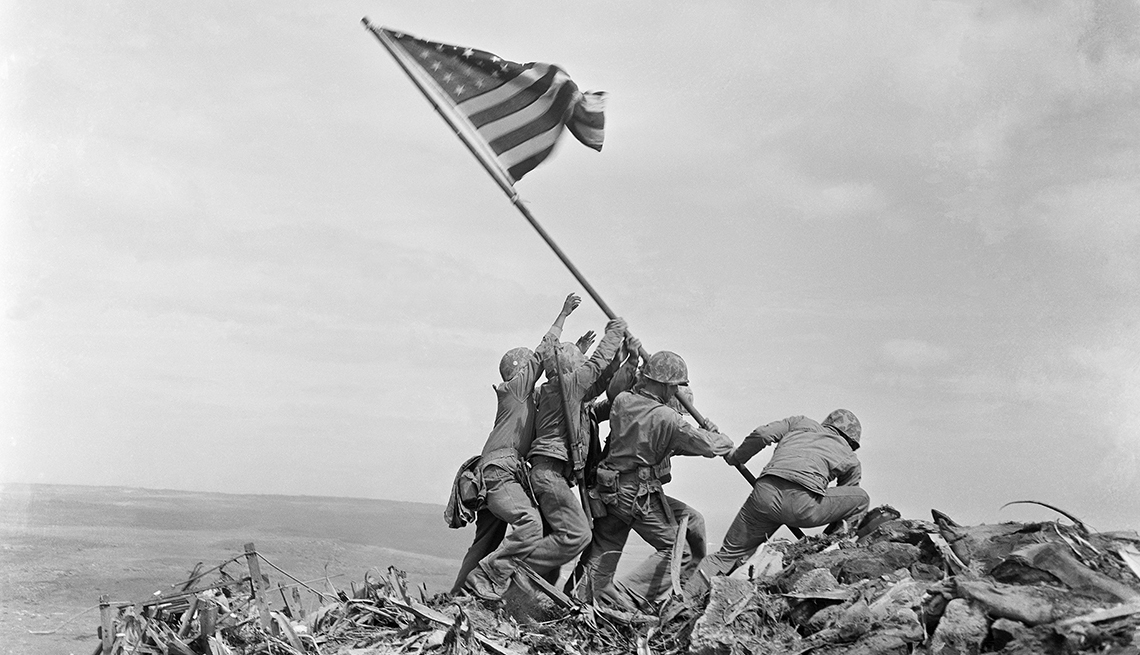
In early 1945, the United States captured the island of Iwo Jima after fierce fighting. The Battle of Iwo Jima (February–March 1945) was a costly but important victory that allowed the U.S. to secure a base close to mainland Japan. These battles marked a significant turning point in the Pacific, as Japan was gradually pushed back toward its home islands.
End of the War (1945)
Fall of Berlin and Germany’s Surrender (May 7, 1945)
In April 1945, the Soviet Red Army encircled Berlin, the capital of Nazi Germany. The Battle of Berlin was one of the final major battles of the European theater, with fierce street-to-street fighting as the Soviets closed in on the city. On April 30, 1945, as Soviet forces neared his underground bunker, Adolf Hitler committed suicide. With their leader dead and the city in ruins, German forces in Berlin surrendered to the Soviets.
On May 7, 1945, Germany officially surrendered to the Allies in Reims, France, bringing an end to the war in Europe. This day is celebrated as Victory in Europe Day (V-E Day) on May 8. The surrender marked the collapse of the Third Reich and the end of Nazi rule, but the war in the Pacific continued for several more months.
Atomic Bombs on Hiroshima and Nagasaki (August 6 & 9, 1945)
Despite the defeat of Germany, Japan continued to fight in the Pacific, though its military situation was increasingly desperate. In a bid to force Japan’s unconditional surrender, the United States dropped two atomic bombs on the Japanese cities of Hiroshima and Nagasaki. The first bomb was dropped on Hiroshima on August 6, 1945, killing an estimated 140,000 people by the end of the year. Three days later, on August 9, 1945, the second bomb was dropped on Nagasaki, resulting in approximately 70,000 deaths.
The unprecedented destruction caused by the atomic bombs, combined with the Soviet Union’s declaration of war on Japan on August 8, compelled Japan to surrender.
Japan’s Surrender (September 2, 1945)
On September 2, 1945, Japan formally surrendered aboard the USS Missouri in Tokyo Bay, officially bringing World War II to an end. This day is known as Victory over Japan Day (V-J Day). The surrender marked the conclusion of the deadliest conflict in human history, with the Allies emerging victorious in both the European and Pacific theaters.